
(function(w,d,s,l,i){w[l]=w[l]||[];w[l].push({'gtm.start': new Date().getTime(),event:'gtm.js'});var f=d.getElementsByTagName(s)[0], j=d.createElement(s),dl=l!='dataLayer'?'&l='+l:'';j.async=true;j.data-privacy-src= 'https://www.googletagmanager.com/gtm.js?id='+i+dl;f.parentNode.insertBefore(j,f); })(window,document,'script','dataLayer','GTM-K39V2PD');
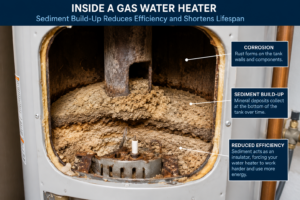
Close-up view of heavy sediment buildup inside a residential gas water heater tank showing mineral deposits, corrosion, and reduced heating efficiency due to lack of maintenance.
Tesla Powerwall and Battery Backup FAQ2026-11-02T16:59:31+00:00

Tesla Powerwall is a rechargeable home battery that stores electricity for use later. Depending on how your system is configured, Powerwall can store energy from solar or the electrical grid, reduce grid use during expensive peak-rate periods, and provide power during an outage.

Tesla explains that Powerwall combines energy monitoring, smart controls and battery storage so homeowners can monitor energy use, battery charge, solar production, and energy flow through the Tesla app.

It can help reduce how much electricity your home draws from the grid during more expensive periods.

SMUD residential solar and battery customers remain on the utility’s Time-of-Day rate as part of the Solar and Storage Rate, where shifting electricity use away from the 5–8 p.m. peak period can help lower energy costs.

Tesla’s Savings Mode is designed to respond to changing utility rates, storing energy when costs are lower and using stored electricity when rates are higher.

Actual savings depend on household energy use, rate plan, solar production, battery configuration, and how the system is operated.

No. Powerwall can operate without solar and may charge from the electrical grid when allowed by the utility and system configuration.

Adding solar changes what the system can do. Solar can charge Powerwall during the day, allowing stored solar energy to be used later in the evening or during an outage. Tesla provides additional information about combining Powerwall with new or existing solar systems.

Pairing battery storage with solar can also extend available backup energy during longer utility interruptions because the battery may recharge when solar production resumes.

Possibly, but power capability and backup duration are two different things.

According to Tesla’s current Powerwall specifications, Powerwall 3 provides 13.5 kWh of stored energy and up to 11.5 kW of continuous power.

That provides enough output for many household loads, but everything operating in the home consumes the battery’s stored energy. Refrigeration, lighting, internet, selected outlets, and essential equipment generally require much less energy than continuously operating air conditioning, electric water heating, EV charging, or other high-demand equipment.

AHES evaluates the loads you want available during an outage before recommending a battery configuration.

Powerwall 3 can support substantial electrical loads when the home and battery system are properly designed. That may include HVAC equipment. The more important question is how long you want those loads to operate. Air conditioning, electric heating, heat pump water heaters, EV chargers, and other large electrical loads can use stored battery energy much more quickly. Tesla’s published Powerwall 3 power and motor-start specifications help determine whether specific equipment can be supported, while AHES evaluates the electrical demand, expected runtime, other household loads, and available battery capacity together.

There is no single number that works for every home. Battery sizing depends on household electricity use, desired backup duration, major electrical loads, solar production, panel configuration, and how much stored energy you want available. Tesla’s current system allows Powerwall 3 Expansion units to add additional battery capacity, making it possible to increase storage for homes with greater energy requirements.

AHES can evaluate your household loads and energy goals before recommending an appropriate system size, call us now and we’ll send a technician to help you plan your battery backup project.

Yes. Powerwall can be integrated with many new and existing solar installations. Tesla provides guidance on combining Powerwall with solar and other home energy systems. The exact design depends on the existing solar equipment, inverter configuration, electrical service, available installation space, and whether additional solar or battery capacity is planned.

AHES can inspect the existing electrical and solar equipment before designing the battery portion of the project. Call us and we’ll send a technician to help you plan your battery backup project.

Yes, qualifying SMUD customers may have access to battery-storage incentives through the utility’s My Energy Optimizer® Partner+ program.

The program is not limited to Tesla. SMUD currently lists qualifying battery systems from Tesla, Enphase, FranklinWH, SolarEdge, sonnen, and Eguana. This gives Sacramento homeowners several battery-storage options depending on their existing electrical system, solar configuration, energy goals, and project design. For projects submitted under SMUD’s current incentive tier, enrollment incentives can reach up to $6,000 per household depending on battery capacity and program requirements.

SMUD currently provides ongoing quarterly Partner+ incentives specifically for qualifying Tesla battery systems. PG&E customers should review the utility’s current rebates and clean-energy incentive programs, as eligibility and available funding can vary by program, customer, location, and project.

Because incentive programs and funding can change, AHES recommends confirming current eligibility before building a project budget around a rebate.

Call us and we’ll send a technician to help you plan your battery backup project.

Battery storage works best when it is designed as part of the home’s larger energy system. AHES can evaluate the electrical panel, household loads, HVAC equipment, water heating, existing or proposed solar, future electrification plans, available rebates, and backup priorities before recommending a battery configuration. That whole-home approach allows electrical, solar, HVAC, water heating, insulation, roofing, and other improvements to be coordinated rather than treating the battery as an isolated piece of equipment.

Call us and we’ll send a technician to help you plan your battery backup project.

Yes. American Home Energy Savers offers several ways to explore financing for a Powerwall or other home battery-storage project. You can start by reviewing our AHES home improvement financing options and then work with our team to determine which financing path may fit your project.

Depending on the property, project scope, credit profile, and current lender requirements, available options may include traditional home-improvement financing, PACE financing, home-equity financing, and utility-related financing programs.

For traditional home-improvement financing, AHES works with or has relationships with financing platforms including GreenSky, GoodLeap — formerly Loanpal — Regions Home Improvement Financing, and OPTIMUS Financing. Our financing page also references Mosaic; its former site now routes existing borrowers through Solar Servicing, so current new-project availability should be confirmed with AHES before relying on that option.

Eligible California homeowners may also be able to use Property Assessed Clean Energy (PACE) financing. AHES works with PACE providers including Home Run Financing and Renew Financial. Both currently offer California PACE programs, and Renew Financial specifically lists energy storage and backup systems among eligible home-improvement categories. PACE financing is repaid through a property assessment and is subject to property, location, underwriting, and program requirements.

Homeowners with sufficient equity may also consider a home equity line of credit (HELOC) or home-equity loan. Because these products use the home as collateral, we recommend understanding the terms and risks before choosing this route; the Consumer Financial Protection Bureau’s HELOC guide provides a useful independent overview.

SMUD customers can also ask about currently available utility financing and energy-efficiency loan programs. Because eligible equipment and program terms change, battery-storage eligibility should be confirmed directly through SMUD’s customer and loan-financing resources before including utility financing in a project budget.

Financing programs, interest rates, promotional terms, and eligibility can change, and not every financing product will apply to every battery installation. AHES can review financing alongside available battery rebates so you can compare the total project cost, not just the equipment price.

Call us and we’ll send a technician to help you plan your battery backup project.

Heating and Air Conditioning FAQ2026-10-27T03:21:17+00:00

HVAC replacement may make sense when equipment is aging, becoming unreliable, requiring increasingly frequent repairs, struggling to maintain comfortable temperatures, or operating less efficiently than it once did. Uneven temperatures, excessive noise, short cycling, poor airflow, or steadily increasing heating and cooling costs can also indicate that the system deserves a closer look.

At American Home Energy Savers, we prefer an inspection-first approach. Before recommending replacement, we evaluate the heating and cooling equipment along with important supporting systems such as ductwork, airflow, insulation, thermostat operation and electrical capacity. Sometimes repairing a specific problem is the sensible solution; in other homes, replacing outdated equipment can provide better comfort, reliability and efficiency over the long term.

You can learn more about the range of home energy services available from AHES, including HVAC, ductwork, insulation and electrical improvements.

Choosing HVAC equipment should involve more than simply replacing an old unit with another unit of the same tonnage. Proper system design considers the size and construction of the home, windows, insulation, orientation, ductwork, airflow, equipment location and the heating and cooling demands of the building.

The Air Conditioning Contractors of America (ACCA) recognizes Manual J for residential heating and cooling load calculations, Manual S for equipment selection and Manual D for residential duct design. These standards help contractors evaluate what a home actually needs instead of relying only on the size of the equipment being replaced.

AHES evaluates the existing HVAC system as part of the larger home. This whole-home approach can help identify airflow, duct, insulation or electrical issues that should be addressed when planning a new heating and air conditioning system.

A heat pump is an electric heating and cooling system that moves heat rather than creating heat through combustion. During Sacramento’s cooling season, it moves heat from inside the home to the outdoors much like a conventional air conditioner. During cooler weather, the process reverses and transfers available outdoor heat into the home.

The U.S. Department of Energy’s heat pump guidance explains that heat pumps can provide both heating and cooling and are available in ducted, ductless, multi-stage and variable-speed configurations.

For Sacramento homeowners considering electrification, a heat pump can replace separate heating and cooling equipment while creating an opportunity to coordinate related improvements such as ductwork, insulation and electrical upgrades.

In many Sacramento-area homes, yes. A properly selected heat pump can provide both heating and cooling and may replace the functions of a traditional gas furnace and central air conditioner.

Whether that is the best solution for a particular home depends on the heating and cooling load, existing duct system, airflow, electrical capacity, equipment location and the homeowner’s comfort goals. Modern two-stage and variable-stage systems can adjust their output as conditions change instead of operating at full capacity every time the thermostat calls.

Both the U.S. Department of Energy and SMUD’s heat pump HVAC program provide additional information about modern heat-pump technology. AHES can evaluate the HVAC, duct and electrical systems together before recommending a replacement strategy.

Yes. Converting from gas heating to an electric heat pump can sometimes require a new circuit, additional breaker capacity, a subpanel or an electrical service-panel upgrade.

Because American Home Energy Savers provides both HVAC and residential electrical services, we can evaluate these requirements as part of the overall project instead of treating the electrical work as an unrelated problem.

For qualifying SMUD customers, related electrical improvements may also qualify for utility incentives when they are part of an eligible electrification project. SMUD’s current heating and cooling rebate information includes current requirements for heat pumps and related electrical measures. Program requirements and available funding can change, so eligibility should always be verified before work begins.

Not necessarily. Existing ductwork should be evaluated before deciding whether it can be reused. We look for damaged or disconnected ducts, air leakage, inadequate insulation, restrictive fittings, improper sizing and airflow problems that can prevent new equipment from performing as intended.

If the existing duct system is in good condition and properly sized, replacement may not be necessary. In other homes, sealing, repairing, resizing or replacing portions of the duct system can substantially improve comfort and system performance.

ENERGY STAR’s duct-sealing guidance explains how leaking or poorly connected ducts can contribute to energy loss and comfort problems. ACCA also recognizes Manual D as the residential duct-design standard.

AHES includes ductwork and airflow in our HVAC evaluations because installing efficient new equipment on a poorly performing air-distribution system can leave the underlying comfort problem unresolved.

Absolutely. Your heating and cooling equipment can only condition the air that successfully reaches the rooms in your home and returns to the system.

Leaking, crushed, disconnected, undersized or poorly designed ducts can contribute to weak airflow, hot and cold rooms, excessive equipment run time and unnecessary energy use. Ducts located in Sacramento attics, crawlspaces and other unconditioned spaces can also lose energy when they are poorly insulated or improperly sealed.

According to ENERGY STAR’s guidance on duct sealing, properly designed and sealed ductwork can improve comfort and energy efficiency. AHES can inspect accessible ductwork, evaluate airflow and recommend sealing, repairs, resizing or replacement where appropriate.

Regular HVAC maintenance can help identify developing problems before they become expensive failures and can help maintain proper airflow, temperature control and equipment operation.

A maintenance visit may include evaluating filters, coils, electrical components, condensate drainage, thermostat operation, blower performance, temperature change and other operating conditions depending on the equipment being serviced.

Maintenance needs vary with equipment type, age, usage and conditions around the home. Sacramento’s long cooling season can place substantial demand on air-conditioning and heat-pump equipment, so homeowners should pay attention to changes in airflow, sound, operating time and comfort rather than waiting for a complete system failure.

Yes. Qualifying Sacramento-area homeowners may have access to utility and state incentives for heat-pump HVAC installations and related electrification improvements.

SMUD’s current heating and cooling rebate program provides incentives for qualifying multi-stage heat-pump HVAC systems installed by participating contractors. Requirements can include equipment efficiency, system type, contractor participation and other program rules, and funding remains subject to availability.

Homeowners can also use The Switch Is On Incentive Finder to search for current California rebates and incentives for heat pumps, electrical upgrades, weatherization and other home-energy improvements.

Federal incentives have also changed significantly. The IRS states that the Energy Efficient Home Improvement Credit under Section 25C is not available for property placed in service after December 31, 2025, so homeowners should be cautious about older websites or advertisements that still describe that credit as currently available. View the current IRS guidance on home-energy credit expirations. Because rebate programs and funding can change, AHES can help identify programs that may apply when your project is planned, while final eligibility remains subject to the individual utility or incentive program.

Yes. A complete HVAC replacement, heat-pump conversion, duct improvement or related electrical project can be a significant home investment, and financing can allow homeowners to complete needed improvements without paying the entire project cost upfront.

American Home Energy Savers works with several types of home-improvement financing. Depending on the project and homeowner qualifications, options may include traditional home-improvement loans, PACE financing, home-equity options and utility-related financing.

Rebates and financing should be considered together when planning a project. Available incentives may reduce the amount that needs to be financed, while financing can make it easier to complete related improvements—such as HVAC, ductwork, insulation or electrical upgrades—as one coordinated project.

Visit the AHES Financing page to learn more about available home-improvement financing options, or schedule an inspection so we can evaluate the home and establish the project scope before financing decisions are made.

Roofing FAQ2026-08-09T01:04:44+00:00

Sacramento Roofing Questions

Homeowners often have the same questions when they are deciding whether to repair or replace a roof. Here are some of the most common questions we hear.

How do I know whether my roof needs repair or replacement?

Localized problems such as damaged shingles, flashing issues, or a small leak may be repairable. Widespread deterioration, repeated leaks, damaged decking, or an older roofing system may make replacement the better long-term option. AHES can inspect the roof and explain what we find before recommending a scope of work.

How much does a new roof cost in Sacramento?
Roof replacement cost depends on the size and pitch of the roof, roofing material, tear-off requirements, access, decking condition, dry rot, flashing, and other repairs discovered during the project. An inspection allows us to develop a more accurate project scope and estimate.

Can AHES repair a roof leak without replacing the whole roof?
Yes. If the roofing system is otherwise in serviceable condition, a targeted repair may be appropriate. We look for the source of the leak and evaluate the surrounding roofing materials before recommending repair or replacement.

Can you repair dry rot during a roofing project?
Yes. Roofing problems can expose deteriorated decking, fascia, eaves, rafter tails, and other wood components. As a general contractor, AHES can incorporate related repairs into the roofing scope when appropriate.

What is a cool roof?
A cool roof uses roofing materials designed to reflect more sunlight and absorb less heat than many conventional roofing products. This can be particularly useful in Sacramento’s hot summer climate. Product performance varies, so we can help homeowners evaluate appropriate roofing options.

Do you work around rooftop HVAC equipment, vents, and solar equipment?
Yes. Roof penetrations and rooftop equipment must be properly integrated into the roofing system. The exact scope depends on the equipment and project conditions, and some systems may require coordination with additional trades.

Do I need a permit for a roof replacement?
Permit requirements depend on the project and the local building jurisdiction. AHES can determine the applicable requirements as part of the project planning process.

What areas does AHES provide roofing services in?
AHES provides residential roofing services throughout Sacramento and selected surrounding communities. The service-area section above lists our primary cities and ZIP codes. Properties near the edge of the service territory can contact us to confirm availability.

Sacramento Area Water Heater Maintenance FAQ2026-05-11T16:50:28+00:00

Question:

How often should a water heater be flushed?

Answer:

Most water heaters should be flushed once per year to remove sediment buildup and maintain efficiency, especially in areas with hard water like Sacramento.


Question:

What are signs a water heater is failing?

Answer:

Common signs include rusty water, inconsistent hot water, strange noises, leaks around the tank, and rising utility bills.


Question:

Why does my water heater make popping or rumbling noises?

Answer:

These sounds are often caused by hardened sediment buildup inside the tank, which traps water and reduces heating efficiency.


Question:

How long does a traditional water heater last?

Answer:

Most tank water heaters last between 8 and 12 years depending on maintenance, water quality, and usage.


Question:

Are heat pump water heaters worth it in Sacramento?

Answer:

Yes. Heat pump water heaters are highly efficient in Sacramento’s climate and may qualify for rebates and tax incentives.


Question:

Can sediment buildup damage a water heater?

Answer:

Yes. Excess sediment can overheat the tank, reduce efficiency, damage components, and shorten the lifespan of the system.


Question:

Should I repair or replace my water heater?

Answer:

If the tank is leaking or nearing the end of its lifespan, replacement is often more cost-effective than continued repairs.

Is Your Water Heater Failing Early? Here’s What Most Homeowners Miss

Most homeowners don’t think about their water heater until there’s no hot water left. But by the time a system completely fails, warning signs have usually been there for months—or even years.

At American Home Energy Savers, we regularly find water heaters in Sacramento homes that are working much harder than they should because of one overlooked issue: lack of maintenance.

The good news? Catching problems early can help extend the life of your water heater, improve efficiency, and prevent expensive emergency replacements.

Sacramento Water Can Be Hard on Water Heaters

Sacramento-area water contains minerals that naturally build up inside your tank over time. As water is heated, sediment settles at the bottom of the tank and begins to harden.

That buildup creates several problems:

  • Reduced heating efficiency
  • Longer wait times for hot water
  • Strange popping or rumbling noises
  • Increased wear on heating elements and burners
  • Higher utility bills

Eventually, sediment can cause overheating, corrosion, or even tank failure.

Signs Your Water Heater May Be Struggling

Many homeowners miss the early warning signs because the system is still technically “working.”

Watch for:

  • Hot water running out faster than normal
  • Rust-colored water
  • Rumbling or crackling sounds
  • Moisture around the base of the tank
  • Inconsistent water temperatures
  • Higher gas or electric bills

If your water heater is over 8–12 years old, these symptoms deserve attention sooner rather than later.

Why Annual Flushing Matters

One of the simplest ways to protect a water heater is with an annual tank flush.

Flushing helps remove sediment buildup before it hardens and damages internal components. It can also:

  • Improve efficiency
  • Restore heating performance
  • Reduce strain on the system
  • Extend equipment lifespan

Unfortunately, most water heaters in Sacramento never get flushed at all.

Don’t Ignore Safety Concerns

Water heaters involve pressure, heat, gas, electricity, and plumbing connections. Small issues can become major problems if left unchecked.

A professional inspection can identify:

  • Corrosion
  • Improper venting
  • Pressure relief valve issues
  • Leaks
  • Unsafe exhaust conditions
  • Electrical concerns on heat pump water heaters

In some cases, homeowners discover problems before a complete tank rupture or flooding event occurs.

Heat Pump Water Heaters Are Growing in Popularity

Many homeowners are now upgrading to high-efficiency heat pump water heaters to reduce energy use and qualify for rebates.

These systems can dramatically lower operating costs compared to traditional gas or electric tanks while improving energy efficiency throughout the home.

American Home Energy Savers can help determine whether your current setup is a good fit for an upgrade.

Protect Your Home With Simple Maintenance

At American Home Energy Savers, our maintenance membership includes:

  • Two HVAC maintenance visits per year
  • One annual water heater safety inspection and flush
  • Optional filter delivery plan

Routine maintenance helps homeowners avoid surprise breakdowns and keeps systems operating safely and efficiently year-round.

Title

Go to Top